|
Vice News founder Shane Smith Sitting down with
President Obama discussing non violent drug offenders |
When addressing the use of narcotics and the trade, the measures that have been taken in trying to deal with drug epidemics whether it be heroin, crack, or methamphetamine the response has always been the same, punitive. The punitive response to addicts purchasing drugs doesn't help the addicts or improve their lives, putting addicts through 12 step programs work to some extent, but the nature of the conversation over narcotics hasn't changed, but it needs to. When looking outward at countries who have all but eliminated the epidemics that different nations have suffered one thing is clear, the punitive response doesn't seem to work anywhere. Jailing those who are addicts and those involved in the drug trade has only served to place 1% of the population of the United States in detention facilities. In the home of the free and the brave there are more people in prison than in any other country in the world. One thing that must be clear is that not every solution internationally can be applied to every country, there are extreme measures though that the United States wouldn't be able to adopt. Malaysia and a host of other countries are famous for executing drug traffickers, despite the extreme measures, drug trafficking there is down, but not significantly so. Before offering a solution it might be more beneficial to hear from those suffering from addiction and from law enforcement on what should be done.
The following are stories from addicts as well as law enforcement on their thoughts on the drug war, drugs, and addiction. The content due to its nature may be disturbing or graphic in its content, but is essential to understanding the reality of the situation and addressing possible solutions. The first look at those involved in the drug trade would have to start with those farmers in Mexico, Mexican production of heroin has jumped in order to meet demand. A poppy fame in a Vice special says this when asked about the effect of their work on people. "This plant is all people here have to support themselves with. We're aware that by planting this, we hurt many people. There are many who throw away their lives just to get high."
[1] When looking at the situation in Mexico there really isn't any solution or alternative offered to those who produce poppy flowers and process them into heroin, the situation also is very similar in Columbia and Peru, the worlds largest cocaine producers. Government efforts have been made to combat the production of poppy in Mexico, but the alternatives and incentives for producing anything else isn't viable for these farmers to be able to live.
 |
| Mexican soldier raiding a poppy farmers crop |
When looking at the stories of addicts and where the drugs have gone the urban age of drug use is over and the center of overdoses is in Huntington West Virginia, right in the middle of Appalachia. Huntington is a small community with just near 50,000 people this small city just averages about 3 overdoses a day, a seemingly small number per day that adds up to 1095 overdoses a year. The response has been a money ball kind of response with police intelligence trying to fight the epidemic with statistics and patterns. When looking at the root of the problem in Huntington several things are pointed out by Vice as factors. One of the biggest factors in the recent epidemic is the pharmacuetical industry's skewing of statistics of dependency of the synthetic painkillers like oxycontin. Dr. Andrew Kolodny is a physician who works with Physicians for Responsible Opiod Prescribing and has this to say about the epidemic. "The way you get a blockbuster drug is by getting doctors to prescribe it for things like low back pain, and if its a drug thats very hard to stop taking then you've got the magic formula." The statistic that was used was that less than 1% of these patients were getting addicted to these opiods, but what was cited hundreds of times by experts and doctors was in fact a paragraph from a letter to the editor of the medical journal reviewing the drug.
[1]
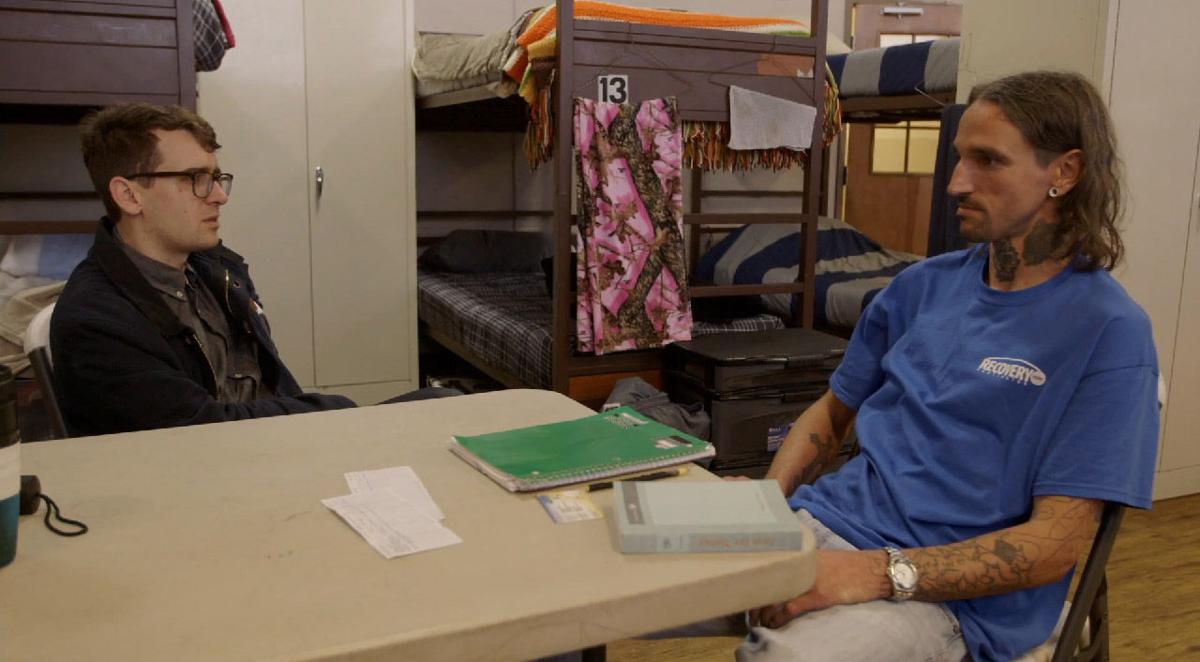 |
| Mickey sits down with Vice journalist Thomas Morton and talks about his addiction. |
Micky, a heroin addict who overdosed in Huntington sat down and talked with Vice reporters and had a lot to say about being an addict. "I lived on the streets, riverbanks, tents, spent winters out there. You would think that would be enough to have a person wanna stop and change, but fuck it didn't stop me. Most people come in here to get to a life they had prior to this, I never had one, it's like learning to walk again." [2] When asked how many times Mickey had overdoes he replied "i've overdosed about 7 times, probably more thats the amount of times i've been to the hospital." The ugly reality is that heroin addiction has touched every person today and if it hasn't it is more than likely to at some point in their lifetime. I myself have a few friends who's siblings have become addicted to heroin, luckily for my friends their siblings have undergone treatment and one of them has become functional and rehabilitated, both have relapsed several times and their journey to heroin began with prescription opioids. Both were young men in their early 20's, white, and stole and sold family members belongings in order to feed their addiction. This is the primary demographic of the addict,
What can we do to fix this system? There isn't one solution as the problem is complex and included a variety of transnational issues that would have to be addressed. The reality is for many addicts that their doctors prescribed them these pain killers and trusted them when told they were safe. In response to having that supply of pills cut off most people turn to heroin to maintain that standard of pain management instead of suffering from a withdrawal from those pills. What awaits those who are caught buying or selling are mandatory minimum sentencing for drug offenders. These minimum sentences are meant to target the upper level people involved in drug trafficking organizations. What began the mandatory minimums was October 1986 in the middle of the crack epidemic. The statutes put put in place were not put in place to reduce crime, but had very much to do with politics and fighting "the war on drugs." This has led to a situation where non violent drug offenders are incarcerated for very long periods of time for crimes and when released have little opportunity and are at higher risk for recidivism. What is interesting is the rate of violent crime nationally has gone down, but the and number of those who have become incarcerated is staggering. [3]
[1] Ackerman, McCarton. "VICE Premieres 'Heroin Crisis' Documentary | The Fix." The Fix. June 3, 2016. Accessed June 20, 2016.
[2] Stuck, Taylor. "Huntington Featured on 'Vice' Heroin Segment." The Herald-Dispatch. June 6, 2016. Accessed July 12, 2016.
[3] "US: Repeal Mandatory Federal Drug Sentences." Human Rights Watch. 2016. Accessed July 2, 2016.