 |
| Number of Incarcerated Americans from 1920-2006 Courtesy of Vice News |
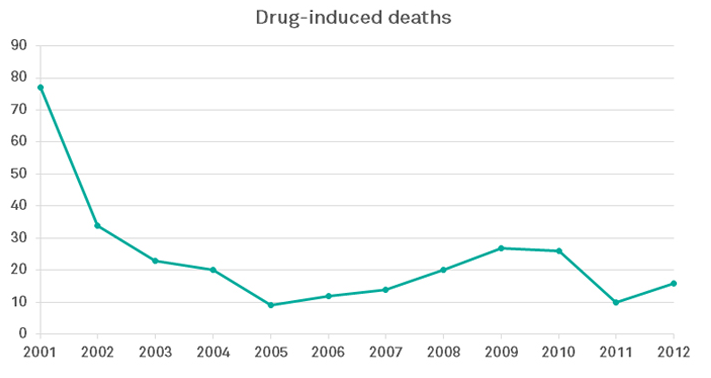
When looking internationally at countries like the Netherlands and Portugal with the most lenient drug laws in the world something interesting has happened with decriminilazation of marijuana and other hard drugs. While other nations like the United States and Britain have approached drug enforcement with harsh punitive measures for low level offenders, Portugal was the first to decriminalize all drugs in 2001. With 15 years having passed since Portugal's decriminalization something astounding has happened, hard drug use and the use of marijuana has dropped. Despite the expectation from critics of the act that Portugal would become the center for drug tourism. The use of marijuana for those over the age of 15 fell to 10% as opposed to the typical 40% average amongst the same demographic in the U.S. As far as hard drug use Portugal's rate of HIV and AIDS dropped 17% after legalization as well as the number of drug induced deaths. [2]
 |
| Statistic Courtesy of TRANSFORM |
Though the solution to the problem seems extreme in response to the problem, in 2001 it was estimated that 1% of Portugal's population was using heroin. The response if a Portuguese citizen is caught with more than a 7 day supply of any controlled substance now involves drug treatment specialists, counselors, and a judge. What has been proven over the 15 years that Portugal has legalized drugs is that those using hard drugs are more likely to seek treatment because users don't face criminal charges. Vans patrol cities offering alternatives to hard drugs and those wishing to be rehabilitated can be directed to state services to help those suffering from addiction. [3] The United States has taken a more progressive look at addiction in recent years in the wake of the heroin addiction that has taken hold. In Massachusetts the police in the Boston area have worked with treatment centers to open supervised injection sites with medical personnel standing by to avoid overdoses. What has been found with programs like these is that addicts are more likely to seek treatment when state services are made available when there is the promise of no charges being brought against users. [4]
Though Portugal in many ways is a success thus far it is hard to tell whether the United States would ever be able to follow suit due to the controversial nature of drug legalization as well as the differences in the legal system. So far there have been no recorded cases with the amount of success that Portugal has had. Heroin and addiction aren't a new issue, but in recent years has grown into an epidemic internationally. Decriminalization might be a solution, but continuing harsh punitive measures has been proven to only worsen the situation.
[1] Anderson, Brian. "So You Want to Abolish Mandatory Minimums for Small-Time Drug Dealers."Motherboard. Accessed July 1, 2016.
[2] O'Neal, Tony. "Ten Years Ago Portugal Legalized All Drugs -- What Happened Next?" Alternet. July 14, 2011. Accessed July 12, 2016.
[3]Aleem, Zeeshan. "14 Years After Decriminalizing All Drugs, Here's What Portugal Looks Like." Mic. 2015. Accessed July 13, 2016.
[4] Murkin, George. "The Success of Portugal's Decriminalisation Policy – in Seven Charts." Transform: Getting Drugs Under Control. July 14, 2014. Accessed June 22, 2016.

No comments:
Post a Comment